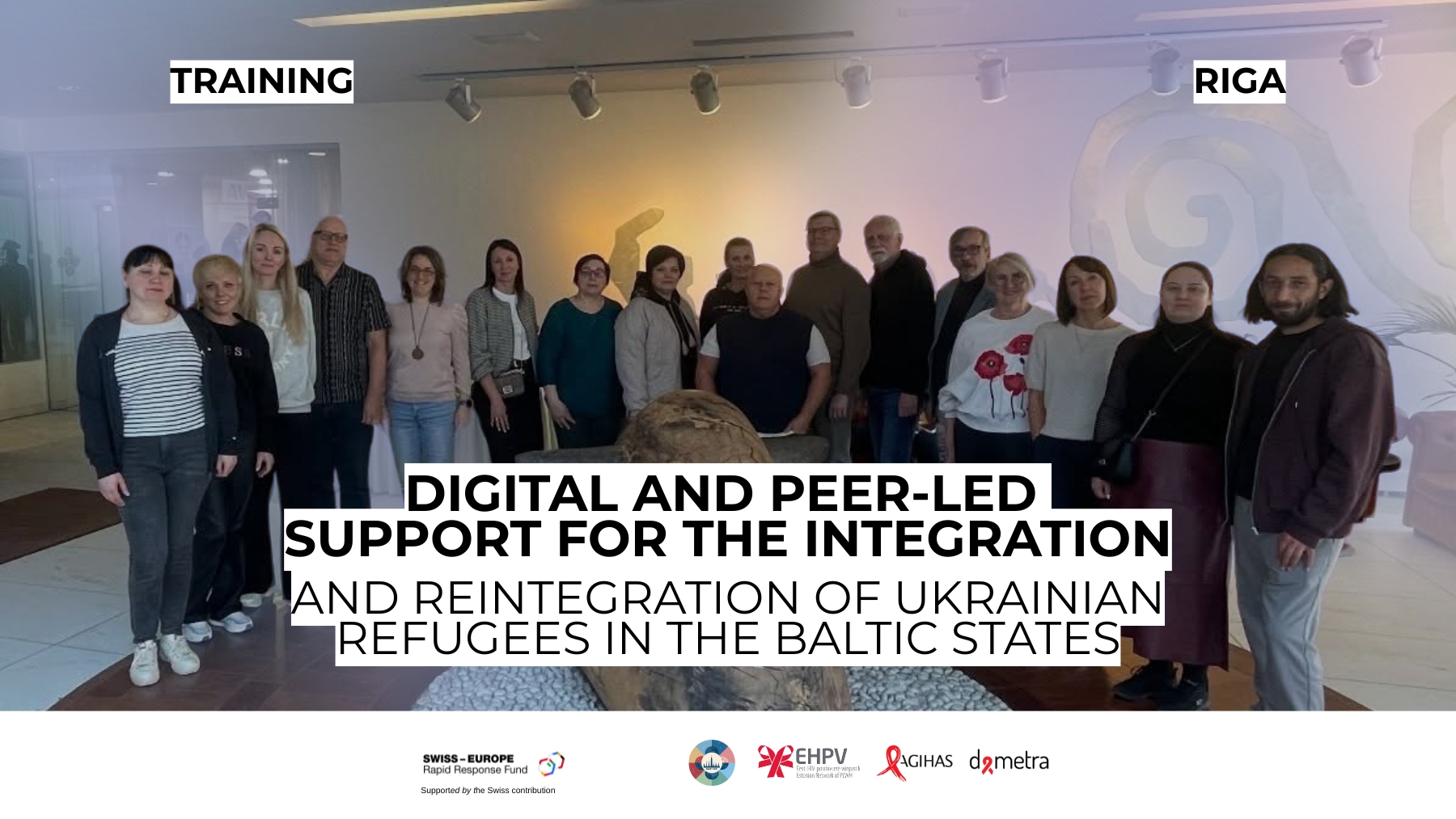
On 28–29 April, a two-day RefAid BaltHUB training took place in Riga for peer counsellors and country coordinators from the Baltic States. It was not just a working meeting about procedures — participants discussed real-life situations, learned how to respond in crisis, communicate without stigma, maintain professional boundaries, and build support that is safe, clear, and truly helpful.
RefAid BaltHUB primarily works with Ukrainian refugees living with HIV in Lithuania, Latvia, and Estonia. For many people who find themselves in a new country, a peer counsellor becomes the first person they can ask difficult questions without fear of judgement. That is why one of the main goals of the training was to establish a shared professional standard of support: so that in every project country, people receive assistance in a careful, confidential, and structured way.
Armen Aghajanov, Project Manager of RefAid BaltHUB: “For us, it is important that RefAid is not a set of separate services, but a living support system. Peer counsellors and country coordinators often meet people at moments of confusion, anxiety, or crisis. In such situations, it is especially important not to lose direction ourselves: to understand our role, know the algorithm of action, and remember that behind every case there is a person who needs not bureaucracy, but a safe point of support.”
The first day of the training focused on the project’s operational manual and standard operating procedures. Participants explored in detail how to manage a case — from the first request to case closure; how to assess the urgency of a request; when to involve the country coordinator; what decisions are made by the commission; and how to document support without disclosing unnecessary personal or sensitive data.
Yulia Golub, trainer of the first day: “SOPs are not ‘paperwork for the sake of paperwork’. They are a way to protect both the person and the team. When a counsellor understands what to do at each step, support becomes calmer, more transparent, and safer. In difficult situations, it is important not to improvise, but to rely on a clear algorithm and the ‘do no harm’ principle.”
The second day was dedicated to the practical toolkit of a peer counsellor. Participants discussed how to use non-stigmatising language, how not to retraumatise people with questions, how to recognise acute stress, and how to help clients regain a sense of control through simple and clear steps. The focus was on a trauma-informed approach, crisis interviewing, stabilisation techniques, creating a client roadmap, and rules for facilitating support groups.
Jekaterina Smirnova, trainer of the second day: “Peer counselling is not rescue work. We do not make decisions for a person and we do not force them to go where they are not ready to go. Our task is to stay alongside them, provide quality information, help set priorities, and outline the next realistic step together. Sometimes this is exactly what helps a person regain a sense of stability.”
A separate training block was devoted to support groups. Participants discussed how to create a safe space where people can talk about their experiences without fear of judgement, receive support, and feel that they are not alone. Support groups are especially important for people who have experienced displacement, loss of stability, disruption of social ties, or difficulties accessing treatment and services. In such a space, participants can not only share challenges, but also find resources, exchange experience, and gradually regain a sense of resilience.
Nataliia Cheporniuk, Country Coordinator in Estonia: “Each partner organisation has its own expertise, and each coordinator and peer counsellor has unique and powerful experience in providing services to war refugees from Ukraine. This training helped us reach a common ground — to standardise the delivery of our services within this project.”
The Riga training became an important step for the RefAid BaltHUB team. Over two days, participants not only reviewed procedures, but also strengthened a shared understanding of what support within the project should be: professional, humane, careful, and equally high-quality across all countries of implementation.
RefAid BaltHUB continues to develop a system of dignified support for Ukrainian refugees from key populations in the Baltic States — a system in which a person in a vulnerable situation can receive not only information, but also attentive accompaniment, respect for their choices, and confidence that there is a team nearby that knows how to help.